Senate Bill 76 (SB 76) was introduced during the 2026 South Dakota Legislative Session at the request of Governor Larry Rhoden.
Contact your Representatives to Support Senate Bill 76
The bill would authorize the Board of Economic Development to issue loans to South Dakota airports with scheduled commercial air service. Eligibility is tied to metropolitan statistical area population, with provisions that cover both mid-sized and larger metro areas as defined by the United States Census Bureau. In practice, the tool is intended to support the terminal expansion projects underway at Sioux Falls Regional Airport and Rapid City Regional Airport.
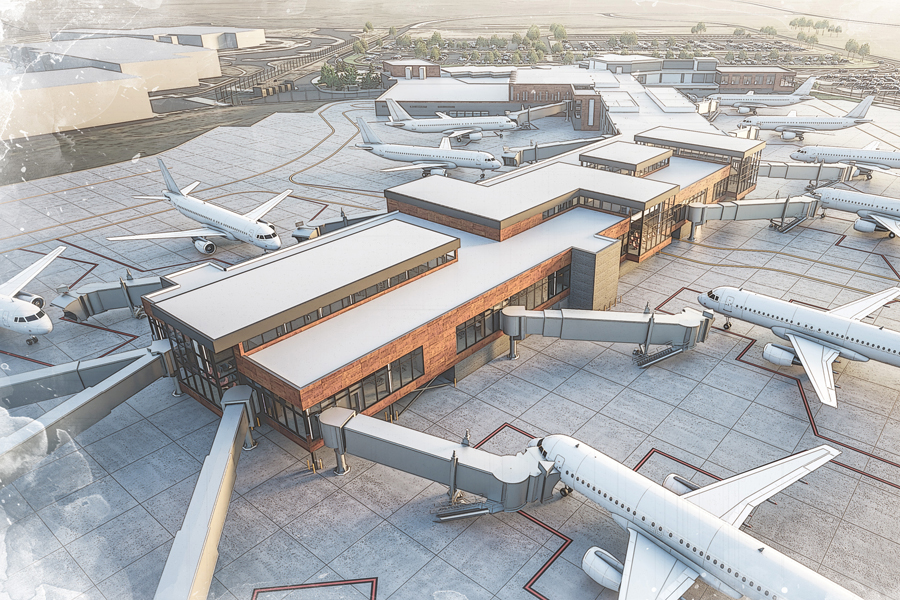
In Rapid City, the next major phase would expand the concourse from 7 to 12 gates, add building systems to better support mainline aircraft, and close a documented 9,000+ square foot holdroom shortage. The plan also improves accessibility, refines concessions flow, and adds non-aeronautical revenue to help the airport remain financially self-sustaining. The total project is roughly $110 million, with approximately $90 million for the concourse building expansion and $20 million for apron expansion, requiring a full funding stack that includes local participation, federal sources, airport revenues, and state partnership.
The structure is straightforward. Loans are capped at $15 million per recipient, must be reviewed and approved at a public meeting, and are repaid back into a revolving fund so the dollars can be reused for future projects.
Terminal projects are long-horizon public infrastructure, and neither gets built with one check.
In Sioux Falls, the airport is advancing capacity work for the same reason: keeping pace with rising passenger demand while protecting operational reliability. In 2025, FSD saw 1,505,874 passengers, a 5.6% increase from 2024. The project total is approximately $51.5 million, including about $42.5 million for an international-capable gate, U.S. Customs and Border Protection updates, and seating and circulation improvements, plus $8.5 million for apron expansion.
When flights stack up during peak season, gates fill, holdrooms overflow, and concourses become bottlenecks. Boarding slows down, turns get tighter, and facility constraints become reliability constraints. Reliability is what protects air service over the long term.
At the same time, airlines are shifting away from smaller regional jets and toward larger mainline aircraft when markets support it. Larger aircraft help meet demand, but they also require more gate space, more holdroom capacity, and better circulation to board and turn efficiently. If terminals can’t process peak demand, the airport becomes the limiting factor.
Both airports are already operating in record-demand territory. Rapid City surpassed 900,000 total passengers in 2025, setting a new high. Sioux Falls continues to carry the largest share of the state’s commercial passenger traffic. For a rural state with long distances between major markets, these airports function as statewide connectivity infrastructure for business travel, medical travel, tourism, emergency response, and day-to-day mobility.
Governor Rhoden’s request for SB 76 reflects a basic reality: airports are core infrastructure, and they need financing tools that match long-term capital projects. SB 76 focuses on structure, repayment, and oversight, providing a defined mechanism for supporting airport infrastructure within existing state frameworks.
Estimated 2025 Airport Economic Impact
Sioux Falls Airport FSD economic impact
Jobs: ~8,795 jobs
Local payroll: ~$409.8M per year
Economic output: ~$897.4M per year
Rapid City Regional Airport RAP economic impact
Jobs: ~5,244 jobs
Local payroll: ~$244.4M per year
Economic output: ~$535.1M per year

Leave a Reply